



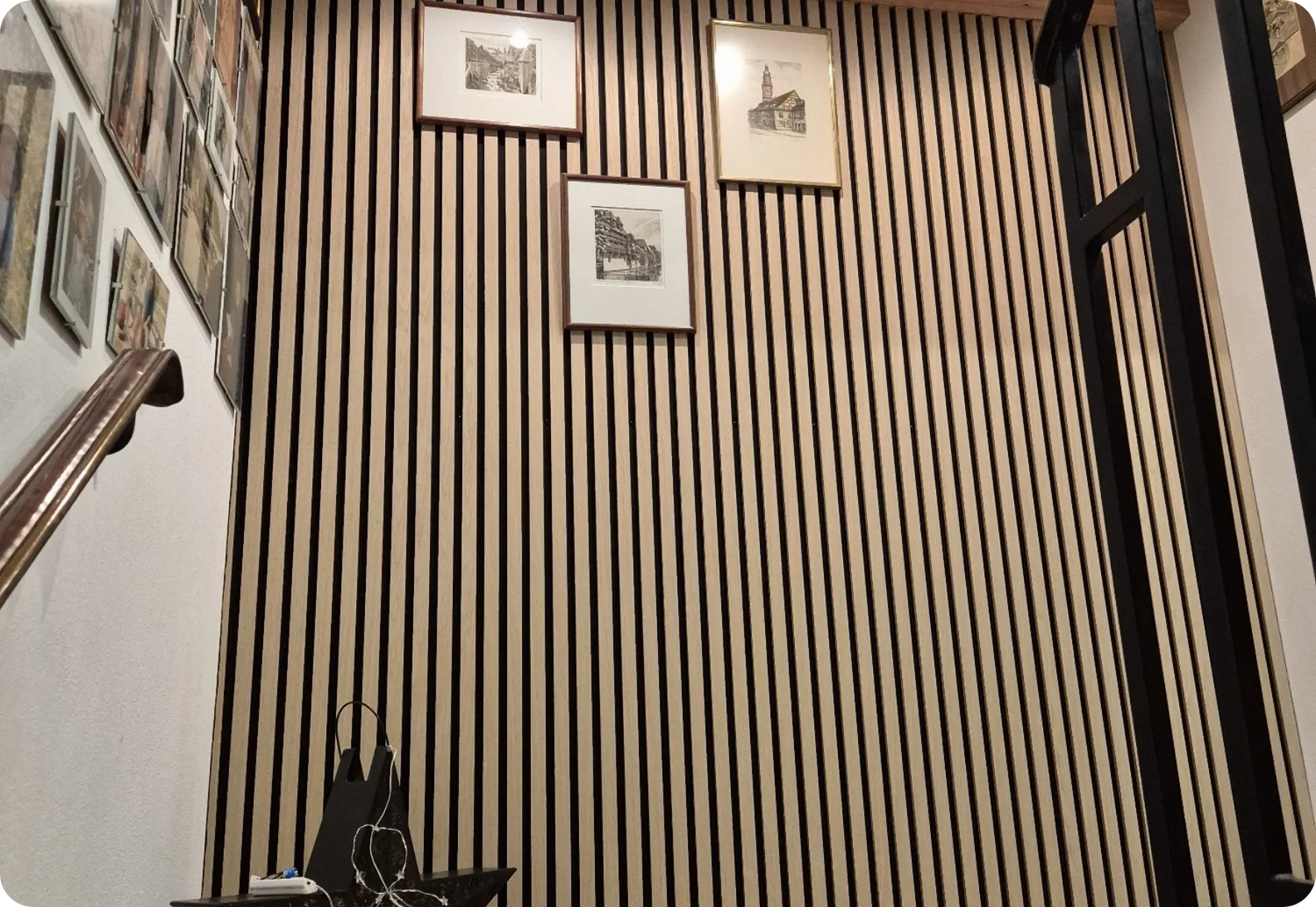
The ceiling is the largest unused surface in any room — here's how to turn it into an acoustic and visual feature
Why Mount Panels on the Ceiling?
Maximum acoustic effect: Sound rises — the ceiling is the surface that reflects the most sound in any room. In a 20 m² room with a 2.5 m ceiling height, the ceiling has 20 m² of reflective surface — more than any single wall. Panels on the ceiling can reduce reverberation more effectively than the same area covered on a wall. For rooms with particularly challenging acoustics (open floor plans, high ceilings, hard floors), ceiling treatment is often the most impactful solution.
Design impact: A ceiling with wood veneer slat panels transforms a room dramatically. The eye is drawn upward, the space feels warmer and more defined. Especially in rooms with white walls, a wood-finished ceiling creates a striking contrast that visitors tend to notice immediately.
Floor space stays free: Unlike rugs or freestanding absorbers, ceiling panels take up zero floor area — ideal for smaller apartments where every square meter matters.

Which Panel Format for the Ceiling?
| Format | Ceiling advantage | Consideration |
|---|---|---|
| 60 × 60 cm | Light (~1.5 kg), easy to hold with one hand, flexible layout patterns | More pieces needed, more seams |
| 242 × 52 cm (Standard) | Fewer seams, continuous slat lines | Heavier (~4.5 kg), requires a helper overhead |
| 242 × 60.5 cm (Premium) | Wider slats, premium look | Heaviest option, definitely requires two people |
For ceiling projects, the 60 × 60 cm panels tend to be the most practical choice — at roughly 1.5 kg each, they can be held in position with one hand while the other drives screws. The full-size panels (4.5 kg) need a second person holding the panel overhead while you secure it — doable, but more demanding.
More on panel formats and dimensions: panel sizes guide.
Step-by-Step: Ceiling Installation
Knock on the ceiling: solid sound → concrete (ideal, screw directly). Hollow sound → plasterboard / drywall (use cavity wall anchors or screw into the supporting rails behind the board). Wooden beam ceiling → screw directly into the beams. Use a stud finder to check for cables or pipes before drilling.
Decide whether you're covering the full ceiling or just a section. A partial ceiling (e.g., only above the dining table or above the sofa) is often more visually striking and more practical than covering the entire surface. Mark the starting line with a chalk line or pencil.
Pre-drill screw holes in the panel. For concrete ceilings: also pre-drill the ceiling and insert wall plugs. For plasterboard: use toggle anchors or similar cavity fixings that grip behind the board. Pre-drilling ensures clean entry and prevents cracking.
Even though screws carry the main load, apply mounting adhesive in S-shaped lines on the back of each panel. The adhesive prevents the panel from vibrating or rattling between screw points. The combination of screws + adhesive provides maximum stability and eliminates any movement or noise over time.
Hold the panel (or have your helper hold it) against the marked position. Drive the panel screws into the pre-drilled holes and tighten securely. The screw heads sit in the slat grooves and are virtually invisible. Place the next panel flush against the first and repeat.
• Screws: 20 per panel — distributed evenly across the surface
• Adhesive: 1 cartridge covers approximately 1.5 panels
• For a 10-panel ceiling island: 200 screws + 7 adhesive cartridges
Installation time: Approximately 10 minutes per 60×60 panel, approximately 20 minutes per full-size panel (with helper). For 10 m² of ceiling area (~28 pieces of 60×60): plan for 4–5 hours with two people.

3 Design Ideas for the Ceiling
💡 1. Ceiling island above the dining table
Cover only the ceiling section directly above the dining table — approximately 2 × 1.5 m (roughly 8 pieces of 60×60). This improves acoustics exactly where conversations happen and visually defines the dining area. Add a pendant light through a pre-drilled hole in one panel — the result looks intentional and architectural.
Panels needed: ~8 (60×60) · Screws: ~160 · Adhesive: ~6 cartridges
💡 2. Continuous ceiling strip
A 60–120 cm wide strip of panels running the full length of the room — for example, centered above the sofa or parallel to a wall. This creates a visual axis and reduces reverberation along the main path of the room. Particularly effective in long, narrow hallways.
Panels needed: varies by length · typically 10–20 (60×60) for a 4–5 m strip
💡 3. Full ceiling coverage
Cover the entire ceiling with panels — the maximum acoustic and visual result. The 60×60 format in a lighter tone tends to work best for full ceilings, as it keeps the room feeling open rather than heavy. For a 20 m² ceiling: approximately 56 panels.
Panels needed: ~56 (60×60) for 20 m² · Screws: ~1,120 · Adhesive: ~38 cartridges
For color recommendations and room-specific ideas: color guide. For more project walkthroughs: top 5 projects.
Ceiling Types and Mounting Methods
| Ceiling type | Mounting method | Notes |
|---|---|---|
| Concrete | Drill + wall plugs + screws | Most secure option. Pre-drill with masonry bit. |
| Plasterboard / drywall | Toggle anchors or screw into rails | Find the metal rails or wooden battens behind the board for strongest hold. Cavity anchors work for lighter 60×60 panels. |
| Wooden beams | Screw directly into beams | Ideal substrate. No plugs needed. Pre-drill to prevent splitting. |
| Suspended / drop ceiling | Not recommended | Grid systems are typically not strong enough. Consider replacing tiles with panels or mounting to the structural ceiling above. |
Frequently Asked Questions
Yes — with screws into the concrete, supporting rails, or wooden beams. Adhesive alone is not sufficient for ceiling mounting because gravity works against the bond permanently. The recommended method is screws plus adhesive together for maximum stability. More on mounting accessories: accessories guide.
20 screws per panel, distributed evenly across the surface. Always use wall plugs in concrete ceilings and cavity anchors in plasterboard ceilings. Pre-drilling both the panel and the ceiling ensures clean entry and a secure hold.
For pure sound absorption: the ceiling is typically more effective per square meter, because sound rises and reflects primarily off the ceiling. The same panel area on the ceiling can absorb more reverberation than on the wall. That said, wall panels are easier to install and still very effective — for the best result, a combination of both ceiling and wall treatment tends to deliver the strongest improvement. More: how effective are acoustic panels?
Yes — use toggle anchors or cavity fixings that grip behind the plasterboard, or screw directly into the metal rails or wooden battens of the supporting structure behind the board. For 60×60 panels (~1.5 kg each), standard cavity anchors are typically sufficient. A stud finder helps locate the supporting structure.
For 60×60 panels (~1.5 kg): one person can manage — hold the panel with one hand, screw with the other. For full-size panels (242 cm, ~4.5 kg): a second person is strongly recommended to hold the panel in position while you screw. For full ceiling coverage: working in pairs makes the project significantly faster and easier.
Lighter tones (Light, Light Brown) tend to keep the ceiling feeling open and airy — especially in rooms with standard ceiling heights. Darker tones (Smoked, Black) can create a dramatic, cocooning effect but may make the ceiling feel lower. For most rooms, a lighter tone on the ceiling with a contrasting darker tone on the wall tends to work well. More: color guide.
Conclusion: The Ceiling Is the Underrated Powerhouse
Ceiling-mounted acoustic panels are one of the most effective ways to improve room acoustics — and visually, they create a statement that draws the eye upward. The installation is more involved than wall mounting (screws are mandatory, a helper is recommended), but the result tends to surpass wall-only solutions in terms of acoustic impact. Start with a ceiling island above the dining table or sofa — it's the entry point that delivers the most noticeable difference with the least effort.
Start with the right format for your ceiling.
The 60×60 cm panels are designed for easy overhead handling — light, compact, and flexible in layout.
View 60×60 cm panels → Free sample box →Installation methods and requirements may vary depending on ceiling type, structural conditions, and specific panel format. Always verify the ceiling substrate and load-bearing capacity before installation. For plasterboard ceilings, check the condition and age of the board before mounting. When in doubt, consult a professional for ceiling assessment.



Napsat komentář
Tento web je chráněn službou hCaptcha a vztahují se na něj Zásady ochrany osobních údajů a Podmínky služby společnosti hCaptcha.