



Why acoustics in most meeting rooms are poor - and how a few panels can make a noticeable difference
Why Conference Rooms Are Particularly Problematic
🔊 Hard surfaces everywhere
The typical conference room consists of glass partitions, drywall, concrete or suspended ceilings (often without absorbers), a smooth table (wood, glass, or laminate), and hard flooring. The result: the vast majority of surfaces reflect sound rather than absorbing it. Every voice, every chair movement, every keyboard click bounces around the room and adds to the noise.
🔁 Parallel surfaces create flutter echo
Conference rooms are usually rectangular - parallel walls can create flutter echoes. Especially between a glass wall and the opposite hard surface, sound can bounce back and forth rapidly. This tends to make speech sound muddled and unclear, and it's one of the reasons people in meeting rooms often feel like they're "not quite hearing" what others are saying.
💻 Video conferences make it worse
Room microphones (Poly, Jabra, Logitech) pick up not only voices but also every reflection in the room. In a reverberant conference room, remote participants can sound like they're in a gymnasium. This can undermine professionalism - especially in client-facing meetings. More on how acoustics affect calls: what panels can and can't do.
What Acoustic Panels Can Actually Achieve
| Aspect | Without panels | With panels (1-2 walls) |
|---|---|---|
| Reverberation | High - speech overlaps with echoes | Noticeably reduced - voices tend to sound clearer |
| Speech clarity | Poor - words can get lost | Improved - participants may follow conversations more easily |
| Flutter echo | Often clearly audible | Typically eliminated or significantly reduced |
| Video call quality | Echoey, unprofessional | Clearer, more professional for remote participants |
| Meeting fatigue | Builds up quickly in long meetings | Can be noticeably reduced |
In conference rooms, speech clarity is typically the most important factor. When reverberation is high, listeners need to work harder to understand what's being said - this creates cognitive fatigue that builds up over the course of a meeting. Reducing reverberation can help people follow conversations more naturally, with less effort. More on room acoustics: room acoustics 5-step guide.
Where to Place Panels in a Conference Room
1. Front wall - behind the screen or whiteboard
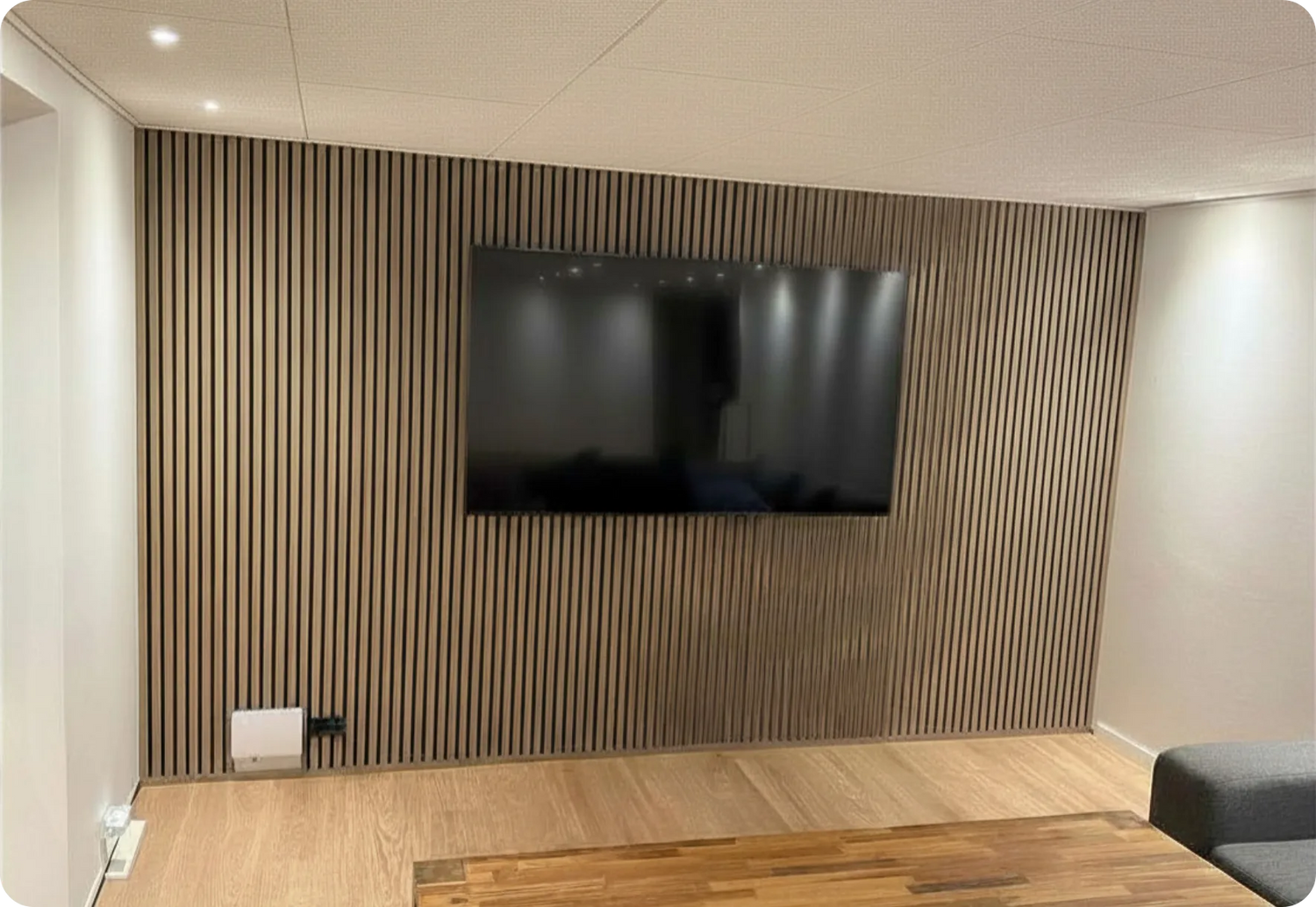
Often the most impactful surface: the wall everyone faces. This is where most speech reflections tend to arrive - from participants speaking toward the screen or presenter. Panels on this wall can have the strongest single effect. The slatted surface also provides diffusion, which can help scatter sound rather than bouncing it directly back.
2. Back wall - behind the participants
The second most effective surface. Sound from the presenter hits this wall and reflects back - creating the echo that can make speech feel unclear. Panels here absorb those reflections before they bounce back into the room. Together with the front wall, this addresses the two main reflection paths in most rectangular meeting rooms.
3. Side wall - opposite the glass partition
If one wall is glass (common in modern offices), the opposite wall becomes especially important. Glass reflects sound almost completely - so the facing wall needs to compensate. Panels on this wall can help break the flutter echo between the glass and the hard surface. This is especially noticeable in narrow meeting rooms.
4. Ceiling - the often-forgotten surface
In rooms where wall space is limited (glass on two or three sides), ceiling treatment can be the most practical solution. Ceiling-mounted panels are less visible but can provide significant absorption. This is especially relevant for larger conference rooms where wall panels alone may not be sufficient. More: ceiling installation guide.
Panel Recommendations by Room Size
| Room size | Typical capacity | Recommended panels | Walls to treat |
|---|---|---|---|
| Small (8-12 m²) | 4-6 people | 6-8 panels | 1 wall (front) |
| Medium (15-20 m²) | 8-12 people | 10-14 panels | 2 walls (front + back) |
| Large (25-35 m²) | 14-20 people | 16-24 panels | 2-3 walls + consider ceiling |
| Boardroom (35+ m²) | 20+ people | 24+ panels | Multiple walls + ceiling |
For exact panel calculations based on your wall dimensions: size calculator.
The Video Conference Factor
In a post-hybrid world, many meetings include at least one remote participant. The quality of the room microphone depends heavily on the room itself - even the best Poly or Jabra system will pick up reverberation from untreated walls and relay it to remote participants.
Acoustic panels can help in two ways: they reduce the reverberation that the microphone picks up (making the speaker's voice cleaner), and they reduce the background noise buildup that can make it harder for the microphone to isolate the primary speaker. Many customers report that remote participants notice the improvement after panels are installed - sometimes commenting on it during the first call.
For home office setups where the same principle applies on a smaller scale: how good are acoustic panels really?
Why Acoustic Panels with a Wood Veneer Finish
There are several ways to treat a conference room acoustically - PET felt panels, foam, fabric-covered frames, or acoustic slat panels with a wood veneer finish. Each has strengths. But in a professional environment where appearance matters, panels with a wood veneer finish tend to offer the strongest combination:
✅ What makes them work for meeting rooms
• They look like an interior design feature, not an acoustic fix
• The MDF slat structure provides diffusion (scatters sound, prevents flutter echo)
• The recycled PET felt backing absorbs sound (reduces reverberation)
• They create a professional, premium backdrop for in-person and video meetings
• They can be installed in 2-3 hours without disrupting the office
• They can be cleaned with a damp cloth - practical for shared spaces
In contrast, foam absorbers provide excellent absorption but tend to look unprofessional in a client-facing meeting room. PET felt panels work well acoustically but are clearly recognizable as acoustic products. Fabric frames are subtle but offer less diffusion. For a detailed comparison: panel types guide.
Practical Considerations
Installation during business hours: Panels can typically be installed using mounting adhesive with minimal noise and no dust. A medium meeting room (10-14 panels) can be completed in 2-3 hours. Schedule during a quiet afternoon or weekend to avoid disruption.
Color choice: In professional environments, medium to darker tones tend to work well - they create contrast against light walls and can feel premium without being overwhelming. Lighter tones can work in smaller rooms where the goal is to keep the space feeling open. Always test with a free sample box before ordering. More: color guide.
LED lighting option: For boardrooms or executive meeting rooms, LED strips behind the panels can add a premium ambient touch. Warm white (2700K) creates a sophisticated atmosphere for evening meetings or presentations. More: LED lighting guide.
Frequently Asked Questions
Depends on room size: a small meeting room (4-6 people) typically benefits from 6-8 panels on the front wall. A medium room (8-12 people) may need 10-14 panels across two walls. Larger boardrooms may require 24+ panels across multiple surfaces. For exact calculations: size calculator.
Typically yes - and it's often one of the most noticeable improvements. Room microphones pick up reverberation from hard walls. Reducing that reverberation can make voices sound clearer and more professional for remote participants. Many customers report that colleagues notice the difference during the first call after installation.
This is common in modern offices. Treat the non-glass walls with panels, and consider ceiling-mounted panels for additional absorption. Even treating just one solid wall can make a meaningful difference. The glass-opposite-wall position is usually the most impactful starting point.
Mounting adhesive is the most common method and typically leaves minimal marks if removed later. For rental offices or spaces where wall integrity matters, this is usually the preferred approach. Screws can be added for extra security on solid walls, especially for ceiling installation.
No - acoustic panels absorb sound within a room (reducing echo), but they do not block sound between rooms. For privacy between adjacent meeting rooms, structural measures (thicker walls, sealed doors) are typically required. Panels can help reduce the amplification of transmitted sound by lowering internal reverberation. More: absorption vs insulation.
Medium to darker tones tend to look most professional - they create a premium backdrop without feeling heavy. For rooms with limited natural light, lighter tones can help keep the space feeling open. Test in your actual space with a free sample box - screen colors can be misleading, especially under office fluorescent lighting. Full guide: color guide.
Conclusion: Better Meetings Start with Better Acoustics
Most companies invest in conference tables, screens, and video systems - but overlook the room itself. A meeting room with poor acoustics can make every meeting more tiring, every video call less professional, and every discussion harder to follow than it needs to be. Acoustic panels on 1-2 walls can change that - often in a single afternoon, with no structural changes required. It's one of the simplest and most impactful upgrades a company can make to how its people communicate.
Acoustic performance depends on many factors including room size, geometry, existing surfaces, panel placement, and coverage area. Results may vary between installations. Reverberation and speech clarity improvements described are based on general acoustic principles and customer observations, not guaranteed specifications. Fire safety and installation requirements vary by building type and region. Prices mentioned correspond to the current prices at the time of publication and are subject to change.


Leave a comment
This site is protected by hCaptcha and the hCaptcha Privacy Policy and Terms of Service apply.