



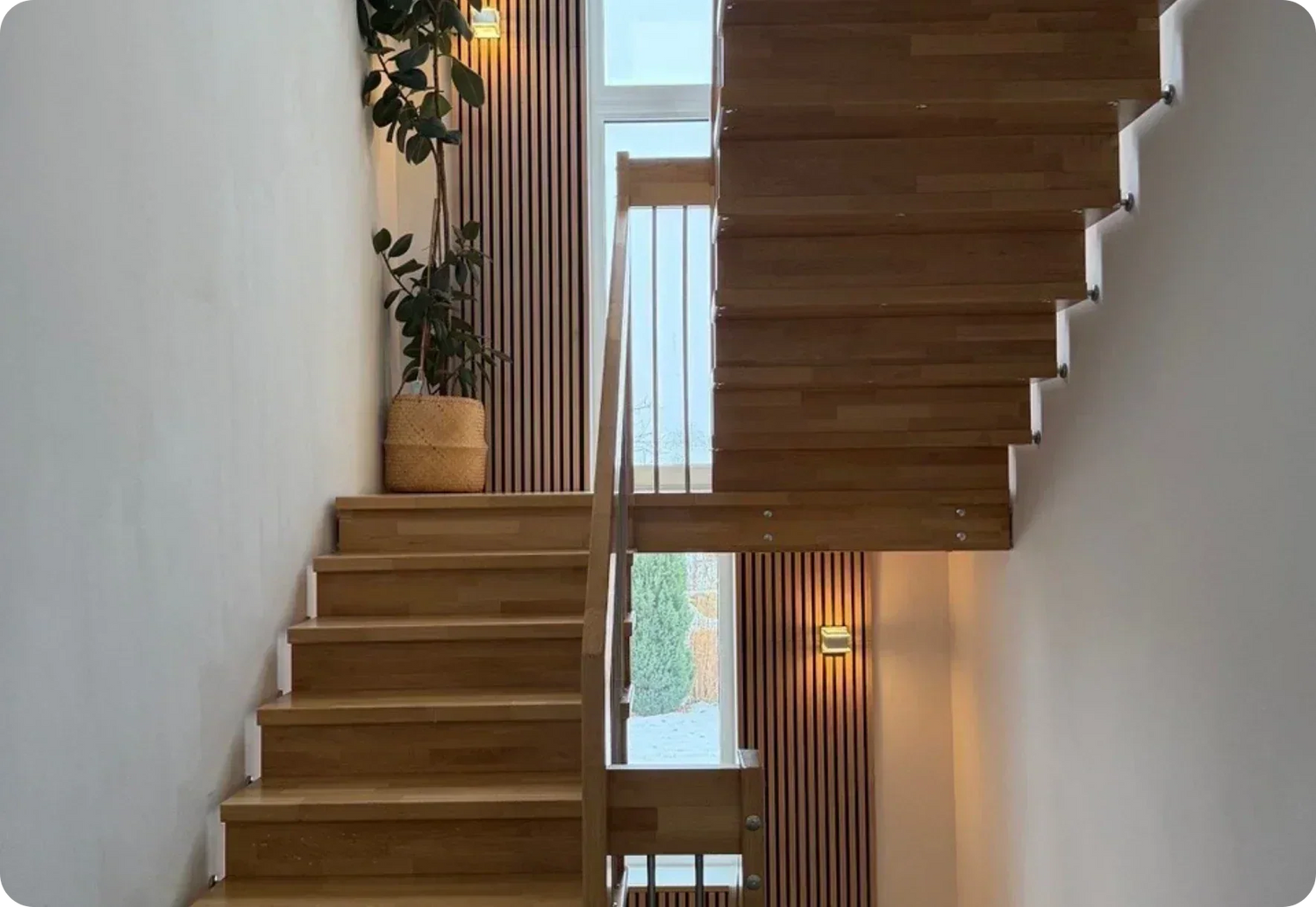
The honest material comparison — what you get, what you feel, and what lasts
The 3 Material Types
1. Real wood veneer on MDF
A thin layer of real wood (0.3–0.6 mm) applied to an MDF core. Every panel has a unique grain — no two panels look exactly the same. The surface feels like real wood because it is real wood. On the back: recycled PET felt for sound absorption.
What you see: Natural grain that varies from panel to panel
What you feel: Warm, slightly textured, natural
How it ages: Develops a subtle patina — tends to look better over time
2. Printed plastic foil on MDF
A wood-look pattern is printed onto plastic foil and glued onto MDF. From a distance (2+ m), it can look like wood. Up close, the differences become apparent: the grain pattern repeats every 60–80 cm, the surface feels smooth and cool, and the foil can reflect light unnaturally from certain angles.
What you see: Repeating pattern — identical every 60–80 cm
What you feel: Smooth, cool, plastic
How it ages: Can peel at edges, yellow over time, scratches expose white MDF underneath
3. Full plastic (PVC / polystyrene)
Entirely molded from plastic — no wood, no MDF. Very light, flexible, water-resistant. The slat structure is created by compression molding. The look and feel are the furthest from natural wood.
What you see: No real grain — uniform, artificial surface
What you feel: Cool, thin, lightweight
How it ages: Can become brittle, yellow with UV exposure, lose color over time

The Full Comparison
| Criterion | Real wood veneer | Plastic foil on MDF | Full plastic |
|---|---|---|---|
| Close-up appearance | ⭐⭐⭐⭐⭐ Natural, unique | ⭐⭐⭐ Acceptable from distance | ⭐⭐ Visibly artificial |
| Touch / feel | Warm, natural, slightly textured | Smooth, cool, plastic | Cool, thin, lightweight |
| Grain pattern | Unique per panel | Repeats every 60–80 cm | No real grain |
| Lifespan | 15+ years, ages beautifully | 5–10 years, foil may peel | 5–8 years, yellows, becomes brittle |
| Scratch resistance | Good (grain hides minor scratches) | Poor (scratches expose MDF) | Medium (scratches visible) |
| Moisture resistance | Good (veneer is flexible) | Medium (MDF can swell) | Very good (waterproof) |
| Sustainability | Renewable, recyclable | Partially recyclable | Plastic, difficult to recycle |
| Cutting / trimming | Jigsaw | Jigsaw | Utility knife or saw |
What Most People Overlook
The aging effect
Real wood veneer can develop a patina over the years — the tone may warm slightly, the surface gains character. This is similar to how solid wood furniture often looks better after a decade than on day one. Plastic foil ages differently: it can yellow, edges may lift, and small scratches expose the white MDF underneath. Full plastic can become brittle and lose its color with UV exposure.
The acoustic difference
Acoustic performance depends not on the front surface, but on the backing. Panels with a felt or fleece backing absorb meaningfully more sound than panels without. Many budget plastic panels have no felt backing — they may look like acoustic panels but provide little to no actual absorption. Always check whether a felt backing is included before buying. More on how this works: how good are acoustic panels really?
The long-term cost
A panel that costs less upfront but lasts 5–8 years may end up costing more than a panel that lasts 15+ years without replacement. Over the full lifespan, real wood veneer panels can be the more economical choice — you buy once instead of 2–3 times. More on the calculation: cost guide.

Which Material for Which Situation?
Real wood veneer — for living rooms, bedrooms, home offices, commercial spaces, and any room where appearance, feel, and longevity matter. The combination of natural aesthetics and acoustic function tends to be hard to match with other materials. More on the materials we use: our materials guide.
Plastic foil on MDF — can be acceptable for temporary installations, short-term rentals (under 3 years), or utility spaces where appearance is less critical. If choosing this option, always check that a felt backing is included for acoustic function.
Full plastic — primarily suitable for wet rooms (bathrooms) or outdoor-adjacent areas where wood and MDF are not appropriate. Generally not recommended for living spaces — neither acoustically nor aesthetically. More on outdoor alternatives: outdoor guide.
Frequently Asked Questions
For living spaces, real wood veneer tends to be the stronger choice: more natural appearance, warmer feel, longer lifespan (15+ years vs 5–10), and often better acoustics (when a felt backing is included). The visual and tactile difference is noticeable immediately — especially up close.
Yes — up close, immediately. Real wood veneer has a unique, non-repeating grain and feels warm and slightly textured. Plastic foil repeats its pattern every 60–80 cm, feels smooth and cool, and can reflect light unnaturally. From 3+ meters, the difference is less obvious. The best way to see for yourself: order the free sample box.
Under normal indoor conditions: 15+ years. The veneer ages like wood furniture — developing a warm patina that tends to look better over time. Plastic foil panels typically last 5–10 years before peeling, yellowing, or showing visible wear. Full plastic can become brittle within 5–8 years. More: sustainability guide.
Yes — the felt or fleece backing is what actually absorbs sound. Without it, the panel is purely decorative — sound bounces off the surface just like any other hard wall. Many budget panels lack a felt backing. Always confirm this before buying if acoustic improvement is a goal. More: panel types comparison.
Real wood veneer with a felt backing — the combination of natural aesthetics and acoustic function tends to be the strongest option for living spaces. The panel looks like a design feature while also improving how the room sounds. For color recommendations per room: color guide.
Conclusion: Material Makes the Difference
The choice of material determines whether your accent wall still looks as good in 5 years as it did on day one — or whether foil peels and edges swell. Real wood veneer on MDF with a felt backing is the combination that tends to deliver the best long-term result: natural look, warm feel, acoustic function, and a surface that ages gracefully rather than deteriorating. The difference is not subtle — and it's one you can feel the moment you hold a sample in your hand.
Material properties described are based on typical product specifications and general industry observations. Actual performance and longevity depend on specific products, installation conditions, and use environment. Prices mentioned correspond to the current prices at the time of publication and are subject to change.


Leave a comment
This site is protected by hCaptcha and the hCaptcha Privacy Policy and Terms of Service apply.