



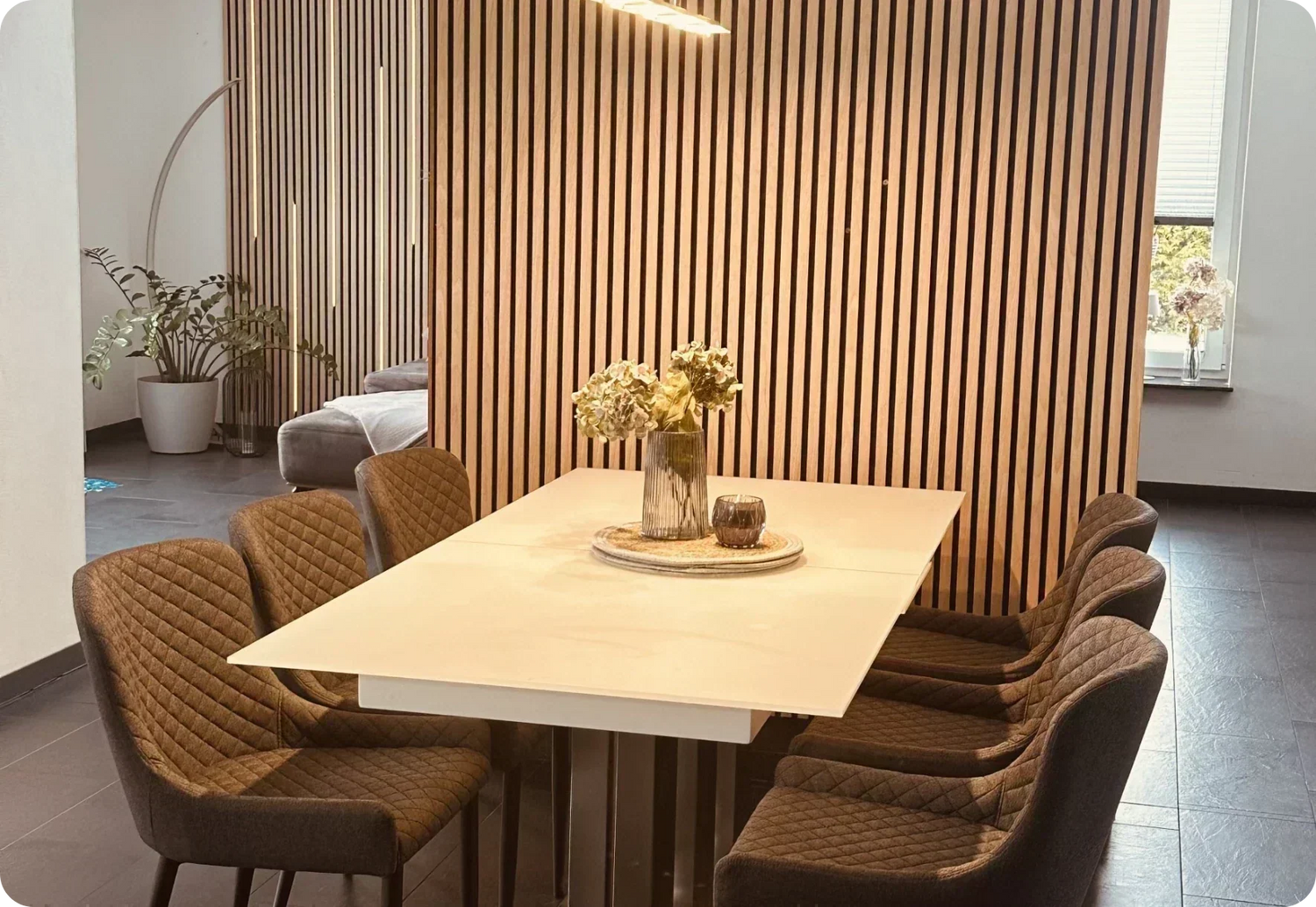
The truth: in most cases you don't need one - but there are exceptions
Do You Need a Subframe?
❌ No subframe needed
• Plasterboard / drywall (flat)
• Wallpapered walls (standard wallpaper, fleece)
• Smooth plaster
• Concrete (flat)
• Tiles
• Wood / OSB board
→ ~90% of all installations. Mount directly with adhesive and/or screws. Done.
✅ Subframe recommended
• Wall with more than 5 mm unevenness
• Cables or pipes to hide behind panels
• Old buildings with wavy plaster
• Rubble stone / natural stone walls
• Walls with significant moisture issues
• Desire for an additional insulation layer
→ ~10% of cases.
The quick test: Hold a long spirit level (at least 1 m) or a straight board flat against the wall and check for gaps. Gaps smaller than 5 mm → direct mounting works fine. Gaps larger than 5 mm → a subframe can level out the unevenness and give you a perfectly flat mounting surface.

Why Direct Mounting Works for Most Walls
Many panel manufacturers recommend a subframe as standard - this often has more to do with their panel construction than actual necessity. Well-constructed acoustic panels have an advantage: the MDF core is rigid enough to bridge small irregularities (up to 5 mm), and the felt backing compensates for minor surface variations. Combined with an elastic mounting adhesive that also absorbs tolerances, the system works directly against the wall without an intermediary structure.
Skipping the subframe saves not only material costs but also 1-2 hours of build time and approximately 3 cm of room depth that a subframe would add. In narrow hallways or compact rooms, that difference can be noticeable.
When You Do Need a Subframe: How to Build It
Materials needed
| Material | Dimensions | Quantity (for a 3 m wall) |
|---|---|---|
| Wooden battens | 24 × 48 mm | ~7 pieces at 3 m length |
| Screws + wall plugs | 6 × 60 mm | ~30 pieces |
| Spirit level | min. 1 m | 1 |
| Spacer wedges (optional) | - | As needed for uneven spots |
Step-by-step: Building the subframe
Hold the spirit level horizontally at various points across the wall. The highest point (where the wall protrudes most) is your reference - the batten sits flat against the wall there. At all other points, spacer wedges fill the gap behind the batten to create a level surface.
Mount the battens horizontally, spaced approximately 40 cm apart. Start about 5 cm below the ceiling and work downward. For a standard 242 cm high wall, you'll need approximately 6-7 battens. Use 6 × 60 mm screws with wall plugs - 4-5 screws per batten.
Check each batten with the spirit level - both horizontally and in alignment with neighboring battens. Where the wall recedes, slide spacer wedges between the wall and the batten until all battens form a single flat plane. This is the most important step: a crooked subframe means crooked panels.
This is the ideal moment to run cables, light wiring, or outlet feeds behind the subframe. The 24 mm depth of the battens is sufficient for standard electrical cables. Mark the cable exit points so you know where to cut openings in the panels later.
Screw the panels directly into the battens - no adhesive needed when mounting to a wooden subframe, since wood-to-wood screw connections hold firmly. The panel screws sit in the slat grooves and are virtually invisible. Place the next panel flush and repeat.
Total time: Subframe build approximately 1.5-2 hours for a 3 m wall. Panel mounting on subframe approximately 1 hour. Total: 2.5-3 hours.

Special Situations
Hiding cables behind panels
The most common reason to build a subframe: HDMI cables behind a TV wall, wiring for LED strip lighting, or outlet repositioning. The 24 mm depth of standard battens provides enough space for flat cables. For thicker cable conduits, use 30 × 50 mm timber instead.
Damp or cold exterior walls
On exterior walls with moisture issues, a subframe creates an air gap between the wall and panel that can help prevent mold formation. Important: leave 1-2 cm of open space at the top and bottom so air can circulate behind the panels. Note that panels are not a moisture solution - if a wall has serious damp problems, address the underlying cause first before covering it.
Old buildings with wavy plaster
In older buildings with lime plaster or historic masonry, wall unevenness of 1-3 cm is common. Here, a subframe is typically the only way to create a flat mounting surface. Use spacer wedges generously and check each batten carefully with a spirit level. The extra effort pays off - the panels will sit perfectly flat even when the wall behind them is far from it.
Direct Mounting vs Subframe - Side by Side
| Factor | Direct mounting | With subframe |
|---|---|---|
| Wall requirement | Flat (≤ 5 mm deviation) | Any condition |
| Depth from wall | ~21 mm (panel only) | ~45 mm (batten + panel) |
| Installation time (3 m wall) | ~1-1.5 hours | ~2.5-3 hours |
| Cable routing | Not possible | Yes - behind battens |
| Attachment method | Adhesive + optional screws | Screws into battens (no adhesive needed) |
| Skill level | Beginner-friendly | Basic DIY skills needed |
| Reversibility | Adhesive leaves minimal traces | Screw holes in wall from battens |
| Recommended for | ~90% of projects | ~10% of projects |
Frequently Asked Questions
In most cases, no. Panels can be mounted directly to flat walls (plasterboard, smooth plaster, concrete, tiles) using adhesive and/or screws. A subframe is only needed for significantly uneven walls (over 5 mm deviation), for hiding cables, or for special wall types like rubble stone or heavily aged plaster.
Hold a spirit level (at least 1 m long) or a straight board flat against the wall at several points. If the gaps between the level and the wall are under 5 mm - direct mounting works. If they're larger - a subframe can level things out. This 30-second test tells you everything you need to know.
With standard battens (24 × 48 mm) plus the panel (~21 mm): approximately 45 mm total from the wall surface. Without a subframe, the panel sits only about 21 mm from the wall. In narrow hallways or compact rooms, that 24 mm difference can be relevant.
Planed softwood battens (24 × 48 mm) are standard - available at any hardware store. For rooms with higher humidity, use pressure-treated battens. Slightly larger timber (30 × 50 mm) offers more depth for cable routing and a bit more structural rigidity.
Yes - it's a straightforward DIY project. Screw battens horizontally to the wall, level them with spacer wedges, done. You need a cordless drill, wall plugs, a spirit level, and spacer wedges. A 3 m wall takes approximately 1.5-2 hours. Full installation overview: accessories guide.
No - when mounting to a wooden subframe, screws alone are sufficient. The screws go through the panel into the battens (wood-to-wood connection), which holds firmly without adhesive. This is different from wall mounting, where adhesive is the primary attachment method. More on mounting methods: mounting orientation guide.
Conclusion: Less Is Usually More
A subframe is not a requirement - it's a solution for specific problems. For the majority of homes with standard walls (plasterboard, plaster, concrete), panels mount directly to the surface with adhesive and screws. This saves time, material, and room depth. If you do need a subframe, it's a basic DIY project that takes under 2 hours with standard materials from any hardware store - straightforward, not intimidating.
Not sure? Start with the spirit level test. Hold it against your wall, check the gaps. Under 5 mm → mount directly. Over 5 mm → build the subframe. Either way, the result is the same: a perfectly flat, acoustically effective, visually striking panel wall.
For most walls, all you need is this:
Mounting adhesive, optional screws, and your panels. No subframe, no complexity.
View accessories → Free sample box →Wall conditions vary significantly between buildings. The 5 mm threshold is a general guideline - actual suitability for direct mounting depends on the specific wall surface, material, and condition. For load-bearing concerns or structural questions, consult a qualified professional. Subframe dimensions and spacing may need to be adapted for specific wall types or panel formats.


Leave a comment
Ovo je web-mjesto zaštićeno sustavom hCaptcha, čija pravila zaštite privatnosti i uvjeti pružanja usluge vrijede.