



The simple formula for every wall and every ceiling — with example calculations for the most common projects
The Basic Formula
For walls (vertical installation):
Wall width in cm ÷ panel width = number of panels (round up)
Standard panel: 52 cm wide · Premium panel: 60.5 cm wide
For ceilings (60×60 cm panels):
Ceiling area in m² ÷ 0.36 m² = number of panels (round up + 5%)
Try the Calculator
Skip the math and use our interactive calculator. Choose your panel type, enter your wall dimensions, and we'll show you exactly how many panels you need — including any extra panels required if your wall is taller than the standard 242 cm panel height.
Plan your acoustic panel installation
Choose panel type, enter your wall dimensions and we'll calculate the rest.
Quick Table: Panels per Wall Width
| Wall width | Standard (52 cm) | Premium (60.5 cm) |
|---|---|---|
| 1.5 m | 3 panels | 3 panels |
| 2.0 m | 4 panels | 4 panels |
| 2.5 m | 5 panels | 5 panels |
| 3.0 m | 6 panels | 5 panels |
| 3.5 m | 7 panels | 6 panels |
| 4.0 m | 8 panels | 7 panels |
| 4.5 m | 9 panels | 8 panels |
| 5.0 m | 10 panels | 9 panels |
With vertical installation, room height generally doesn't matter — the panels (242 cm) can fit most standard rooms (240–260 cm). For room heights under 240 cm: trim the panel at the bottom. For heights above 250 cm: an extension technique can be used.
Example Calculations for Typical Projects
🛋️ Living Room Accent Wall (3.5 m wide)
350 cm ÷ 52 cm = 6.73 → 7 Standard panels
Installation time: approximately 2 hours
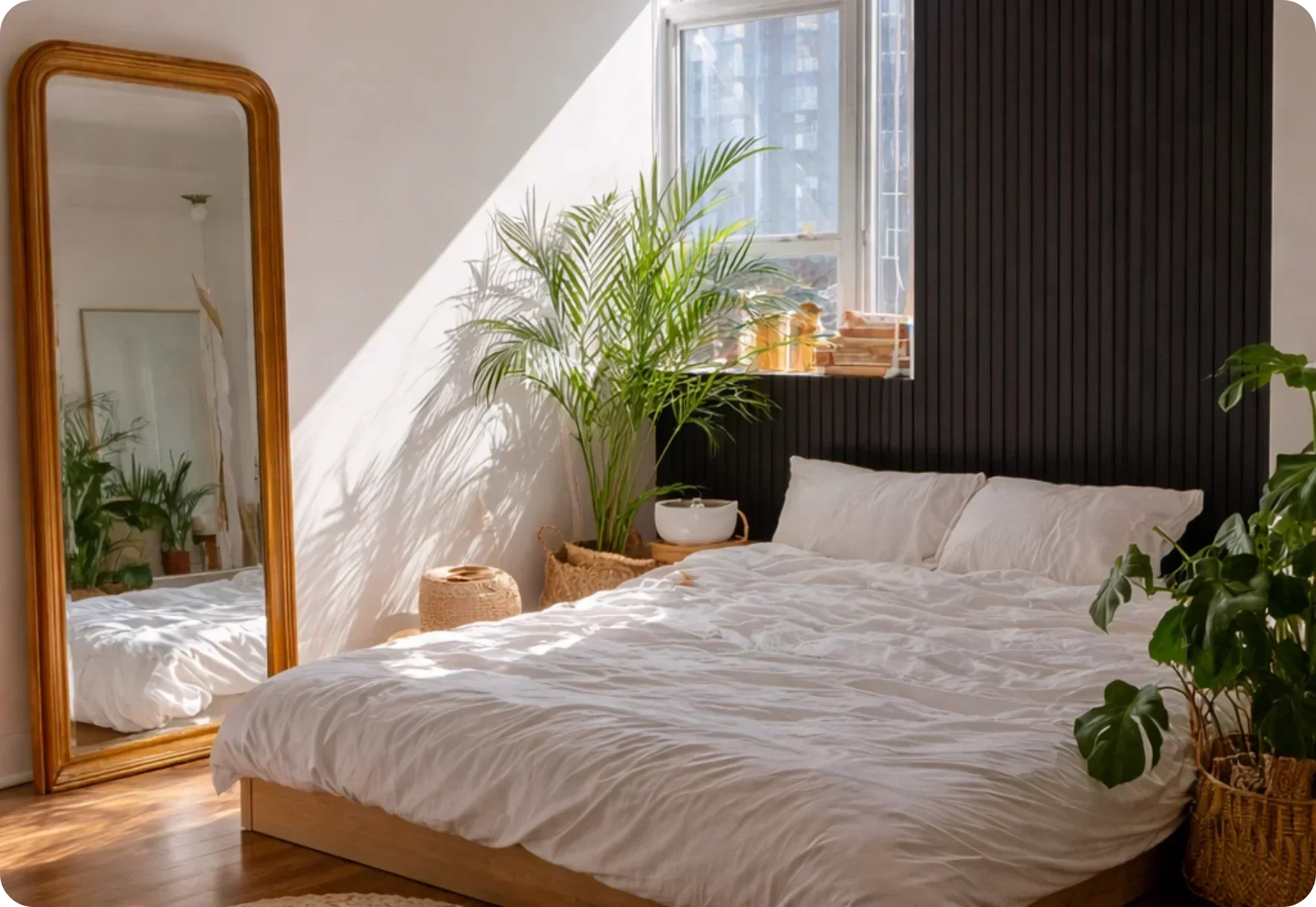
🛏️ Bedroom Headboard (180 cm bed)
200 cm (bed + 10 cm overhang on each side) ÷ 52 cm = 3.85 → 4 Standard panels
Installation time: approximately 60–90 minutes
💻 Home Office Camera Wall (1.5 m behind desk)
150 cm ÷ 52 cm = 2.88 → 3 Standard panels
Installation time: approximately 45 minutes
📺 TV Wall (2.5 m wide, Premium)
250 cm ÷ 60.5 cm = 4.13 → 5 Premium panels
Installation time: approximately 2 hours
✨ Ceiling Island Above Dining Table (2 × 1.5 m = 3 m²)
3 m² ÷ 0.36 m² = 8.33 → 9 panels (+ 1 spare = 10 pieces)
Installation time: approximately 3 hours (two people recommended)
🚪 Hallway — One Side (4 m long)
400 cm ÷ 52 cm = 7.69 → 8 Standard panels
Installation time: approximately 2.5 hours
For full project walkthroughs including styling tips and color recommendations: top 5 projects guide.
Accessories Calculator
| Number of panels | Mounting adhesive | Screws (optional) |
|---|---|---|
| 3–5 panels | 1 cartridge | 1 set |
| 6–10 panels | 2 cartridges | 1 set |
| 11–15 panels | 3 cartridges | 1–2 sets |
| 16–20 panels | 4 cartridges | 2 sets |
One cartridge of mounting adhesive (310 ml) is typically enough for 4–5 panels. Screws are generally optional for drywall, recommended for concrete walls, and typically mandatory for sloped ceilings and ceiling installations.
When Do You Need Extra?
Vertical installation (standard): Typically no extra needed. Panels are placed edge to edge — there's generally no waste except the last panel, which is cut to width. The leftover piece can often be reused elsewhere.
Horizontal installation: Plan approximately 5–10% extra. Panels are cut lengthwise, and leftover pieces don't always fit the next row.
Sloped ceilings: 5–10% extra. Each panel may need to be individually cut to height — leftovers are often too short to reuse.
Ceiling installation (60×60): Approximately 5% extra, as edge panels typically need to be cut.
Frequently Asked Questions
For a single accent wall: measure the wall width in cm and divide by 52 (Standard) or 60.5 (Premium). Round up. Typical: 6–8 panels for a 3–4 m wall. For the entire living room (multiple walls), calculate each wall separately and add them up. More on acoustic coverage: room acoustics guide.
Ceiling area in m² ÷ 0.36 m² (per 60×60 panel) = quantity, rounded up. For a 3 m² ceiling island: 3 ÷ 0.36 = 8.3 → 9 panels. Plan approximately 5% extra for edge cuts.
Only for heights below 240 cm or above 255 cm. Panels are 242 cm high and can fit standard rooms (240–250 cm) without cutting. For lower rooms: trim at the bottom. For higher rooms: extension techniques or baseboards can be used.
Yes — the last panel on a wall is often cut in width. The leftover piece (typically 10–40 cm wide) can be used for niches, room divider frames, or decorative projects. With horizontal installation, leftovers can often be reused for shorter rows.
Standard panels are 242 × 52 cm (1.26 m²). Premium panels are 242 × 60.5 cm (1.46 m²) — wider, which means fewer panels per wall and a slightly different visual rhythm. Both offer the same acoustic properties. For a complete comparison of all panel types: panel types guide.
Conclusion: Calculate Once, Order Correctly
The calculation takes 30 seconds: measure wall width, divide by panel width, round up. No architect, planner, or special tools needed. Order the exact amount plus accessories — one order, everything in one place, no unnecessary waste.
Panel dimensions refer to Silentwood Standard (242 × 52 cm) and Premium (242 × 60.5 cm) panels. Actual quantities may vary depending on wall irregularities, obstacles (windows, doors, outlets), and installation method. Prices mentioned correspond to the current prices at the time of publication and are subject to change.


Leave a comment
This site is protected by hCaptcha and the hCaptcha Privacy Policy and Terms of Service apply.