



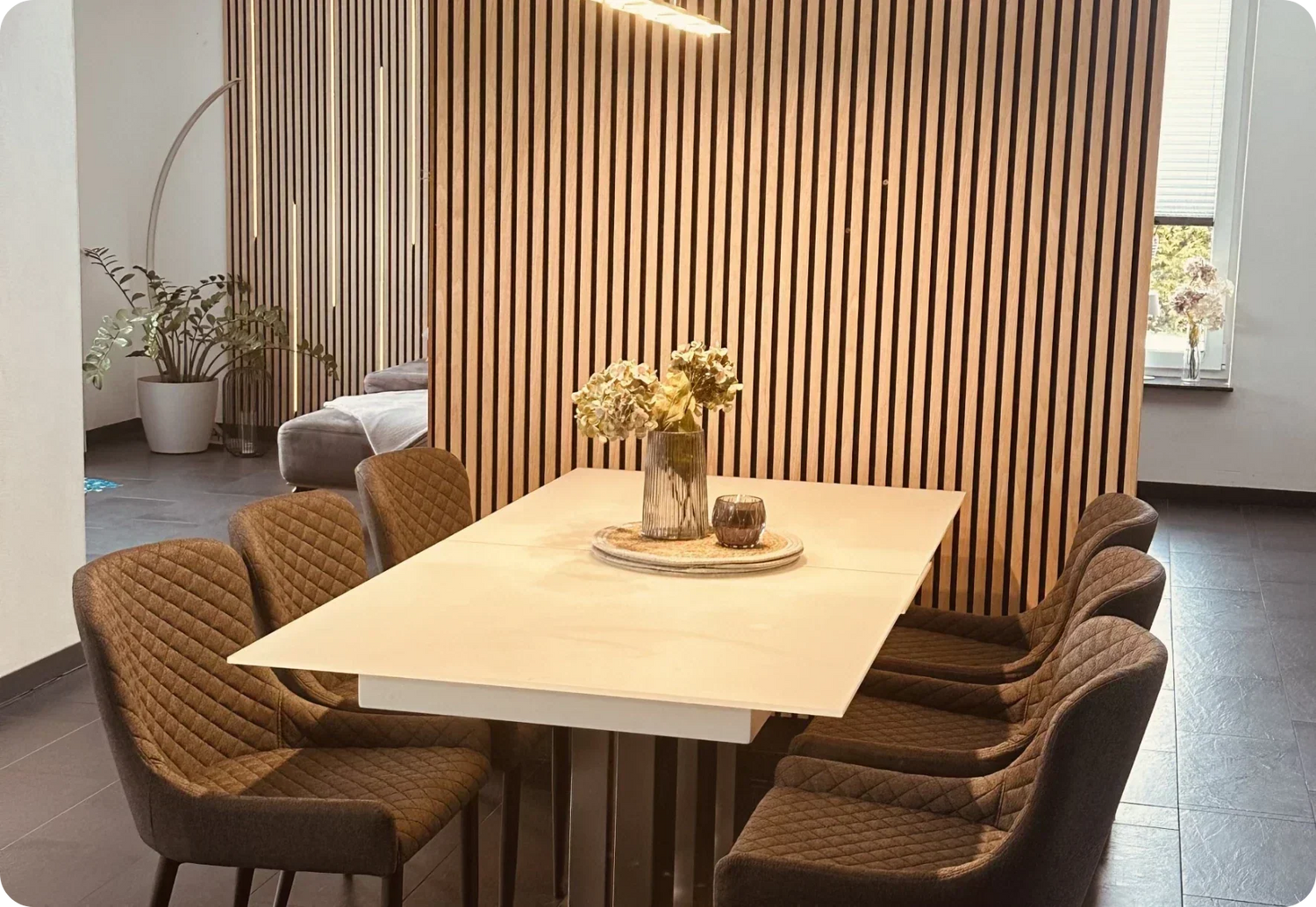
Everything you need to know about acoustic wall panels — from material choice to the finished wall
What Are Acoustic Wall Panels?
Acoustic wall panels are prefabricated elements that mount directly onto existing walls — without altering the wall itself. The most popular format is the slatted panel: vertical slats with evenly spaced grooves that create an architectural, textured surface reminiscent of high-end hotel and designer interiors.
Unlike traditional wall cladding (tongue-and-groove boards), modern acoustic panels are thinner (approximately 2 cm), lighter, and significantly easier to install. The key difference from purely decorative panels: acoustic panels include a felt or fleece backing that absorbs sound, reducing echo and reverberation in the room. More on how this works: how good are acoustic panels really?

Why Wall Panels with a Wood Veneer Finish?
🎨 Instant design transformation
No other wall treatment can change the feel of a room as quickly and dramatically. A blank white wall becomes an architectural accent wall in 2–3 hours — without contractors, without construction dust, without drying times. The slatted texture adds depth, warmth, and visual structure that paint, wallpaper, or plaster simply cannot match.
🔇 Better room acoustics
Panels with a felt backing absorb mid and high-frequency sounds — voices, music, everyday noise — and can reduce reverberation meaningfully. In open-plan layouts, rooms with hard floors, or spaces with high ceilings, the difference tends to be immediately noticeable. More: room acoustics 5-step guide.
🌿 Warmth and natural feel
Wood radiates physical warmth — it feels warmer to the touch than plaster, tiles, or concrete. It also tends to create a psychological effect: rooms with visible wood elements are often perceived as more comfortable, natural, and calming than purely white environments.
🔧 Simple DIY installation
Modern panels mount with adhesive and optional screws directly onto the existing wall. No special tools, no prior experience needed. An accent wall is genuinely an afternoon project. Full details: project guide.
🏠 Renter-friendly
Panels attached with mounting adhesive can typically be installed without drilling and removed without leaving permanent marks. No drill holes, no wall plugs, no disputes with the landlord. This makes them one of the few wall upgrades that work for both homeowners and renters.
⏳ Long lifespan
Panels with a real wood veneer finish can last 15+ years — the veneer develops a subtle patina over time that can increase aesthetic value rather than diminish it. Panels with a plastic foil finish typically last 5–10 years before peeling or yellowing. More on material longevity: sustainability guide.
What to Look for Before Buying
Real wood veneer vs plastic foil
The most important quality distinction. Real wood veneer looks and feels like natural wood, ages beautifully, and typically lasts 15+ years. Plastic foil (PVC-printed decor) can look acceptable from a distance but tends to feel artificial, peel over time, and typically lasts only 5–10 years. Always check what the surface material is before buying.
Felt backing — acoustic or just decorative?
If acoustic improvement matters (and in most rooms it should), always check whether the panel includes a felt or fleece backing. Without it, the panel is purely decorative — sound bounces off the MDF just like any other hard wall. The felt is what makes the difference between a panel that looks good and one that also improves how the room sounds. More: panel types comparison.
Dimensions — floor-to-ceiling vs smaller formats
For accent walls, full-height panels (240+ cm) create the strongest visual impact — no horizontal joints, no visible seams. For ceilings or partial surfaces, smaller formats (60 × 60 cm) can offer more flexibility. For exact calculations: size calculator.

Sizes and Formats
| Format | Typical dimensions | Best for |
|---|---|---|
| Full-height (floor-to-ceiling) | 240–280 × 50–62 cm | Accent walls, TV walls, hallways |
| Square format | 60 × 60 cm | Ceilings, partial surfaces, flexible layouts |
| Small format | 30 × 30 or 30 × 60 cm | Mosaic patterns, accent details, niches |
Silentwood offers Standard (242 × 52 cm), Premium (242 × 60.5 cm), and 60 × 60 cm formats. For help choosing the right size: size guide.
Installation Methods
Installing wall panels is one of the simplest home improvement projects. There are three main methods:
Adhesive only: Apply mounting adhesive to the back, press the panel onto the wall. Ideal for drywall, textured wallpaper, and renters who want to avoid drilling.
Adhesive + screws: The combination for maximum stability. Generally recommended for concrete walls, tiled surfaces, and sloped ceilings.
On a substructure: For significantly uneven walls or when cables need to be hidden behind the panels.
Installation time: approximately 15 minutes per panel. A complete accent wall (6–8 panels) typically takes 2–3 hours. Full step-by-step walkthrough: installation guide.

Which Room, Which Placement?
| Room | Most popular placement | Panels for 3 m wall |
|---|---|---|
| Living room | Accent wall behind sofa | 6 panels |
| Bedroom | Headboard wall behind bed | 4 panels |
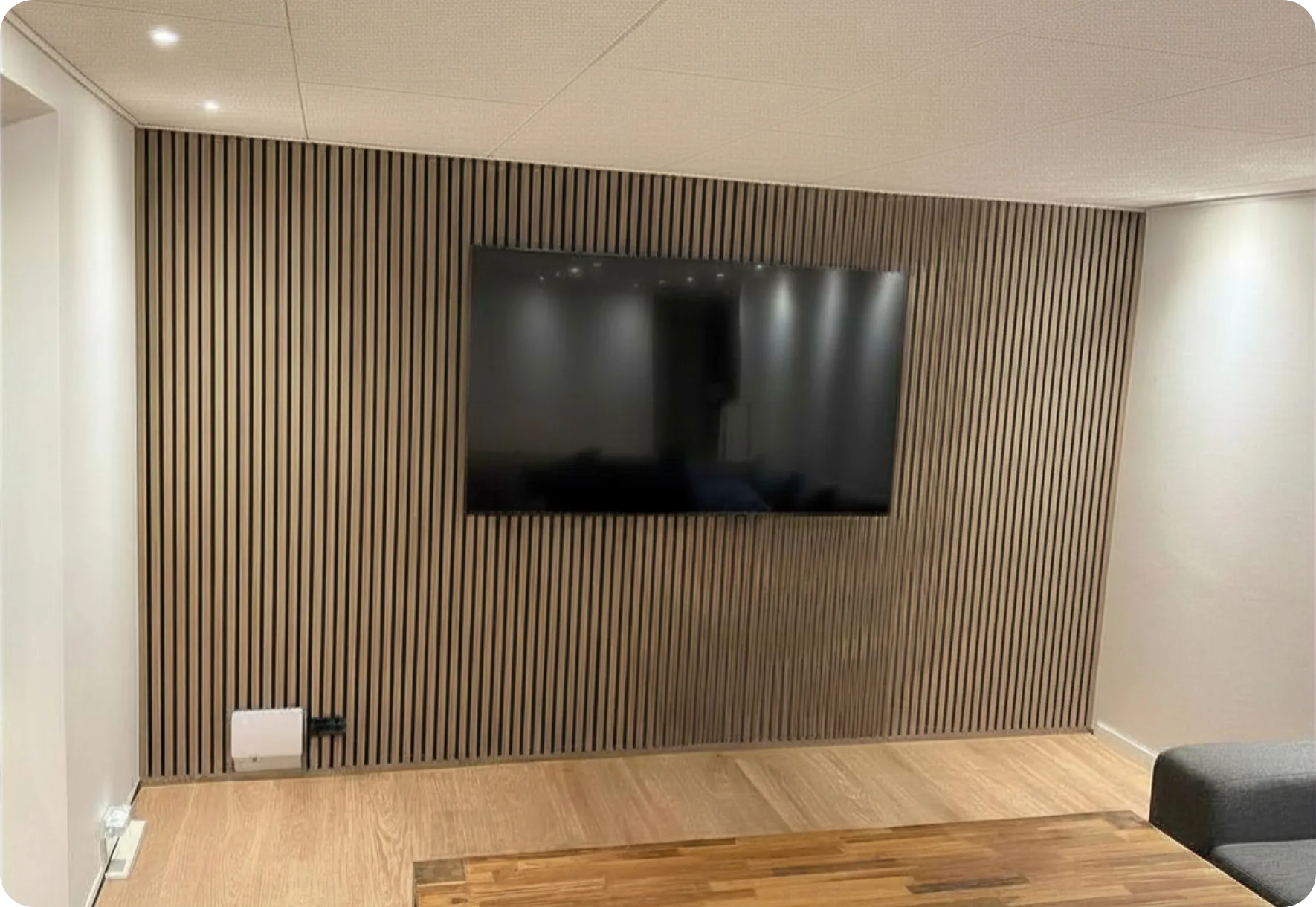
| TV wall | Behind TV / media unit | 5 panels |
| Hallway | One-sided accent wall | 6–8 panels |
| Home office | Video call background | 3–4 panels |
| Kitchen / dining | Dining wall | 5 panels |
| Ceiling | Ceiling island | 8–12 pcs (60×60) |
For color recommendations per room type: color guide. For decoration ideas once the panels are up: decoration guide.
Frequently Asked Questions
Three layers: a real wood veneer surface (the visible finish), MDF slats (the structural core), and a recycled PET felt backing (the acoustic layer). The veneer creates the natural look and feel, the MDF provides stability, and the felt absorbs sound. More: our materials guide.
Yes — it's one of the simplest home improvement projects. Apply mounting adhesive, press the panel onto the wall, align, done. Approximately 15 minutes per panel, a complete accent wall in 2–3 hours. No special tools needed — a spirit level, pencil, and caulking gun are typically enough. More: project guide.
Only if they include a felt or fleece backing. Panels with an acoustic backing can reduce reverberation meaningfully — improving speech clarity, TV sound, and overall room comfort. Purely decorative panels (without backing) have little to no acoustic effect. Always check before buying. More: how good are panels really?
Yes — panels attached with mounting adhesive can typically be installed without drilling and removed without permanent damage. No drill holes, no wall plugs, no disputes. This makes them one of the few impactful wall upgrades available to renters.
It depends on your room, your lighting, and your existing furniture. Lighter tones tend to open up small or dark spaces. Medium tones work in most rooms and are often the most versatile. Darker tones create bold contrast and work well for TV walls or feature walls in well-lit rooms. The safest approach: order a free sample box and test in person. Full guide: color guide.
Acoustic panels include a felt or fleece backing that absorbs sound — reducing echo and reverberation. Decorative panels look similar but have no sound-absorbing layer. If reducing echo matters (and in most rooms it does), the felt backing is the critical feature to check for. More: panel types comparison.
For walls: full-height panels (e.g. 242 × 52 cm) — they cover the wall from floor to ceiling without horizontal joints. For ceilings: square format (60 × 60 cm) — lighter and more manageable. Measure your wall width and divide by the panel width to get the quantity. Full calculator: size guide.
Yes — a self-adhesive LED strip behind the panels creates a warm halo effect. About 15–20 minutes extra installation time. Best installed before mounting the outer panel. Full guide: LED lighting guide.
Conclusion: The Most Versatile Wall Upgrade
Acoustic wall panels with a wood veneer finish combine aesthetics, acoustic function, and simplicity in a way that few other wall treatments can match. An accent wall can be installed in an afternoon, can meaningfully improve how a room sounds, and can transform a blank wall into an architectural feature. Whether it's a living room, bedroom, hallway, or home office — the right panels with the right color can make any wall a highlight.
Acoustic performance depends on many factors including room size, existing surfaces, panel placement, and coverage area. Results may vary between installations. Lifespan estimates are based on typical indoor residential use conditions. Installation methods and suitability may vary depending on wall type and condition. Prices mentioned correspond to the current prices at the time of publication and are subject to change.


Napsat komentář
Tento web je chráněn službou hCaptcha a vztahují se na něj Zásady ochrany osobních údajů a Podmínky služby společnosti hCaptcha.