



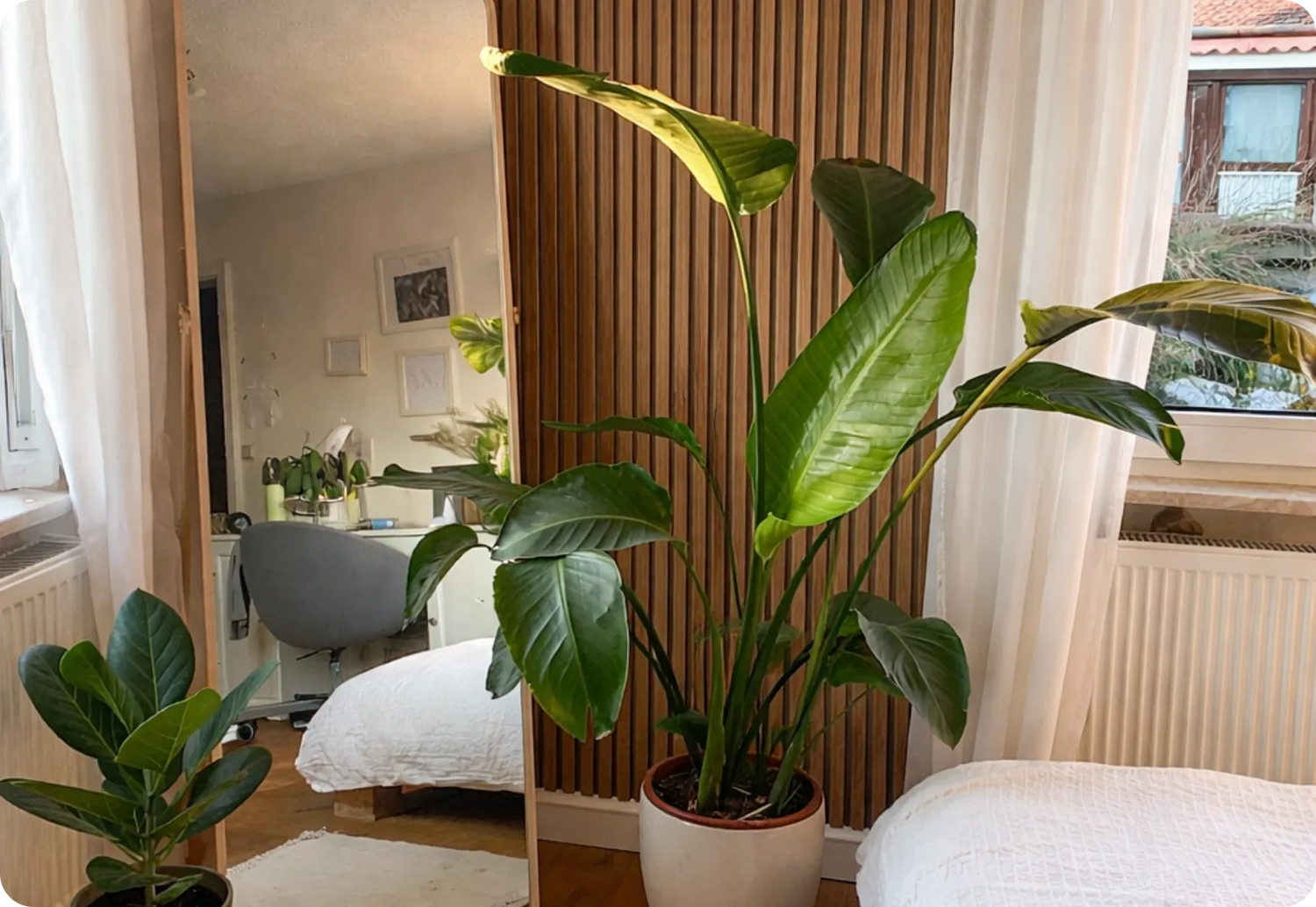
Facts, measurements, and honest limits — what you can expect and what you can't
What the NRC Value Really Means
The NRC (Noise Reduction Coefficient) is the internationally standardized metric for sound absorption. It indicates the proportion of sound a material can absorb upon impact — averaged across the frequencies 250, 500, 1000, and 2000 Hz.
| Material | Typical NRC | What it means |
|---|---|---|
| Concrete wall (smooth) | ~0.02 | Reflects nearly all sound — maximum echo |
| Drywall | ~0.05 | Almost complete reflection |
| Standard window | ~0.10 | Minimal absorbing surface |
| Wood floor (parquet) | ~0.10 | Hard and reflective |
| Thin carpet | ~0.25 | Moderate floor absorption |
| Heavy curtain | ~0.35 | Good absorption, especially at windows |
| Thick carpet (high pile) | ~0.40 | Good for floors |
| Acoustic panels with felt backing | ~0.6 | Strong absorption for living spaces |
| PET felt panels (9 mm) | ~0.75 | Professional absorption (office) |
| Foam pyramids (50 mm) | ~0.85 | Studio-grade absorption |
| Mineral wool (100 mm, freely suspended) | ~0.95 | Industrial absorption |
With an NRC around 0.6, acoustic panels with felt backing rank in the upper third of residential absorption materials. They can absorb more than carpets, curtains, and typical furnishings — but less than professional studio treatment. For living spaces, this tends to be an effective range: the room can become noticeably quieter without sounding "dead."
 Practical Expectations: Before vs. After
What can happen when you install an accent wall with 6–8 panels in a typical 20 m² living room (parquet floor, drywall, 2.5 m ceiling height)?
| Metric | Before (bare walls) | After (1 accent wall) | Potential improvement |
|---|---|---|---|
| Reverberation time (RT60) | Often 1.2–1.8 s | Can drop to 0.5–0.8 s | Meaningfully shorter |
| Speech intelligibility | Moderate | Often noticeably improved | Clearer conversations |
| Perceived noise level | Normal | Can feel several dB quieter | Room tends to feel calmer |
| Flutter echo (clapping) | Often clearly audible | Usually strongly reduced | Can be nearly eliminated |
| TV/music sound | May feel thin, echoey | Tends to feel fuller, more defined | Often immediately noticeable |
RT60 explained: Reverberation time (RT60) measures how long it takes for a sound to decay by 60 dB — in simple terms: how long a clap echoes in a room. In living spaces, 0.5–0.8 seconds is generally considered pleasant. Many modern apartments with hard floors and large windows can exceed 1.5 seconds — creating the "bathroom effect" many people find uncomfortable.
Which Frequencies Do Acoustic Panels Affect?
Not all frequencies are absorbed equally. A typical absorption profile for an acoustic panel with felt backing:
| Frequency range | Frequency | Typical absorption | What it means |
|---|---|---|---|
| Deep bass | 125 Hz | ~0.15 | Little effect — bass tends to pass through thin absorbers |
| Upper bass | 250 Hz | ~0.35 | Moderate effect |
| Low mids | 500 Hz | ~0.60 | Good effect — male speech range |
| Upper mids | 1000 Hz | ~0.75 | Strong effect — female speech, music |
| High frequencies | 2000 Hz | ~0.80 | Strong effect — sibilance, clarity |
| Very high frequencies | 4000 Hz | ~0.85 | Near maximum effect — rustling, clinking |
Acoustic panels tend to be most effective in the range where most everyday sounds occur: voices (300–3000 Hz), music (200–8000 Hz), and household noise (dishes, keyboards, TV). Deep bass (below 200 Hz) — subwoofers, impact noise, or neighbor bass — is generally barely affected. For that, bass traps are typically required (at least 10 cm thick absorbers in room corners).
What Acoustic Panels Cannot Do
No soundproofing: Panels generally do not reduce noise coming through walls, ceilings, or floors. That typically requires mass (concrete, drywall, mineral wool). More: insulation vs absorption.
No bass absorption: Frequencies below 200 Hz are barely affected by thin felt. If your issue is booming bass (subwoofer, traffic, impact noise), panels typically won't solve it.
No soundproof room: Even with panels on all four walls, the room will not become soundproof. The improvement can be significant, but it's not complete isolation. For professional isolation (studio, rehearsal room), an acoustician is generally required.
No miracles in small quantities: 2–3 panels on a large wall provide only minimal improvement. For a noticeable effect, you generally need at least 4–5 m² of absorption in a 20 m² room — equivalent to a full accent wall (6–8 panels).

How to Maximize the Effect
More surface = more effect. One wall is good, two walls can be better, wall + ceiling is often best. As a rule of thumb: 15–25% of the total room surface (walls + ceiling + floor) covered with absorption materials can be a good target.
Strategic placement. First reflection points tend to matter more than random placement. Sit at your listening position and have someone move a mirror along the wall — wherever you see the sound source (TV, speakers), that is a reflection point.
Combine different surfaces. Panels on walls + carpet on the floor + curtains at windows = three different absorption types capturing sound from different directions. This can be more effective than concentrating all material on one surface.
Work symmetrically. If possible, treating opposite surfaces evenly — e.g., panels on both sides of the listening position — can help prevent acoustic imbalance.
Frequently Asked Questions
For reducing reverberation and echo in living spaces: they can be very effective. Panels with felt backing can reduce reverberation time meaningfully, improve speech clarity, and help make rooms noticeably quieter. For soundproofing (neighbors, street noise), they are generally not effective. The key is having correct expectations.
In most cases, yes. Common feedback includes: "speech is clearer," "TV sounds better," and "the room feels calmer." In video calls, the improvement is often noticeable quickly. Many users find the difference is not subtle — it tends to be obvious.
Generally at least 4–5 m² of absorption in a 20 m² room — equivalent to approximately 6–8 panels. Fewer than 4 panels tends to give only minimal improvement. More than 10 panels can continue improving results but often with diminishing returns. A full accent wall is typically the sweet spot.
Not necessarily. Acoustic performance depends mainly on the felt backing and panel construction, not the price alone. A well-made panel at a lower price point can absorb sound just as effectively as a premium-priced alternative with identical backing. Price differences often come from branding and distribution, not from acoustic performance. More: buying affordably.
A carpet (NRC ~0.4) can help on the floor but generally does not absorb wall reflections. Panels on walls combined with a carpet can create a stronger result — multiple surfaces absorbing sound from different directions. Ideally both, but panels alone can already make a noticeable difference.
Conclusion: Effective for Their Purpose, Honest About Limitations
Acoustic panels are not a miracle solution — but for their intended purpose (reducing reverberation in living spaces), they can work very well. Meaningful reduction in reverberation, and often immediately noticeable improvements in speech and music clarity. Their limitations lie in soundproofing and low frequencies — which require different solutions. With the right expectations, the results tend to be very satisfying.
NRC values and absorption coefficients shown are general industry ranges for product categories measured under standardized test conditions (ISO 354 / ASTM C423). Actual performance in your room depends on many factors including room size, geometry, existing surfaces, panel placement and coverage area. Results may vary between installations. These values do not constitute guaranteed performance specifications for specific products. Prices mentioned in this article correspond to the current prices at the time of publication and are subject to change.


Hozzászólás írása
Ezt a webhelyet a hCaptcha rendszer védi, és a hCaptcha adatvédelmi szabályzata, valamint szolgáltatási feltételei vonatkoznak rá.